
LEARNING.FIELDING.EDU
Welcome to the HOD Doctoral Orientation Moodle site!
- Faculty: Malcolm North
- Faculty: Patrice Rosenthal
COURSE DESCRIPTION:
This course provides a strong embarkation to the doctoral program and a framework for students’ development as scholar-practitioners (no matter their individual starting point). The course provides an opportunity to engage with the scholar-practitioner role and identity, preview key doctoral competencies required for success in the program and encounter various modes of research inquiry and concrete examples of same. The course also provides opportunities to make powerful peer connections with fellow students and faculty, to enter the culture of HOD, and to locate myriad resources that will facilitate success on the program. The course will feature a combination of collective readings/exercises with opportunities to pursue personal scholar-practitioner interests.
COURSE LEARNING OBJECTIVES (COMPETENCIES):
1) Reflect on the nature, possibilities, and challenges of the scholar-practitioner role and locate your own identity and aspirations.
2) Show awareness of key doctoral competences and identify your own priorities for skill development.
3) Envision a personal research interest and develop this through a series of steps.
4) Distinguish between key modes of research inquiry (quantitative, qualitative, mixed methods, and participative approaches) and apply this to a research interest.
5) Discuss a personal research interest in depth through the lens of a selected mode of research inquiry.
This course provides a strong embarkation to the doctoral program and a framework for students’ development as scholar-practitioners (no matter their individual starting point). The course provides an opportunity to engage with the scholar-practitioner role and identity, preview key doctoral competencies required for success in the program and encounter various modes of research inquiry and concrete examples of same. The course also provides opportunities to make powerful peer connections with fellow students and faculty, to enter the culture of HOD, and to locate myriad resources that will facilitate success on the program. The course will feature a combination of collective readings/exercises with opportunities to pursue personal scholar-practitioner interests.
COURSE LEARNING OBJECTIVES (COMPETENCIES):
1) Reflect on the nature, possibilities, and challenges of the scholar-practitioner role and locate your own identity and aspirations.
2) Show awareness of key doctoral competences and identify your own priorities for skill development.
3) Envision a personal research interest and develop this through a series of steps.
4) Distinguish between key modes of research inquiry (quantitative, qualitative, mixed methods, and participative approaches) and apply this to a research interest.
5) Discuss a personal research interest in depth through the lens of a selected mode of research inquiry.
- Faculty: Jennifer Bacon
- Faculty: Katrina Rogers
- Faculty: Earl Thomas
Write a concise and interesting paragraph here that explains what this course is about
- Faculty: Melissa Rivera
- Faculty: Patrice Rosenthal
Systems thinking and analysis provide a lens for making sense of the world that transcends psychology, the individual, and particular entities in isolation. Systems thinking also goes beyond awareness of context to explore relationships and inter-relationships at a given time (system structures), and as they change over time (system dynamics). While systems can be examined at many levels, starting with a family, our course will focus on organizational and community systems, and also explore larger systems that shape our experience today and our possible futures. These larger systems include cultural and technological systems, including artificial intelligence, and digital systems that shape our personal and economic lives on a daily basis.
We will read some thinkers that provide foundations for these ideas to provide a basis for seminar discussion and exploration. Students will have an opportunity to explore and bring for discussion specific systems that are relevant to their own exploration and intellectual concerns.
We will read some thinkers that provide foundations for these ideas to provide a basis for seminar discussion and exploration. Students will have an opportunity to explore and bring for discussion specific systems that are relevant to their own exploration and intellectual concerns.
- Faculty: Miguel Guilarte

In this course students develop understandings of how social, economic, and ecological justice is defined and manifested in various societies. Students analyze these concepts and consider actions that promote more just societies. In addition to its focus on cognitive and intellectual understanding, this course emphasizes effective use of self to prepare students to take meaningful action in a wide range of interpersonal, organizational, and societal contexts. We will examine critically the theoretical and practical applications of a diverse range of writings, as we approach issues of human rights, racism, ecological devastation, power, privilege, sexism, and oppression locally, nationally, and globally.
- Faculty: Philipp Kneis
Write a concise and interesting paragraph here that explains what this course is about
- Faculty: Annabelle Nelson
- Faculty: Melissa Rivera
- Faculty: Patrice Rosenthal
Write a concise and interesting paragraph here that explains what this course is about
- Faculty: Michael Manning
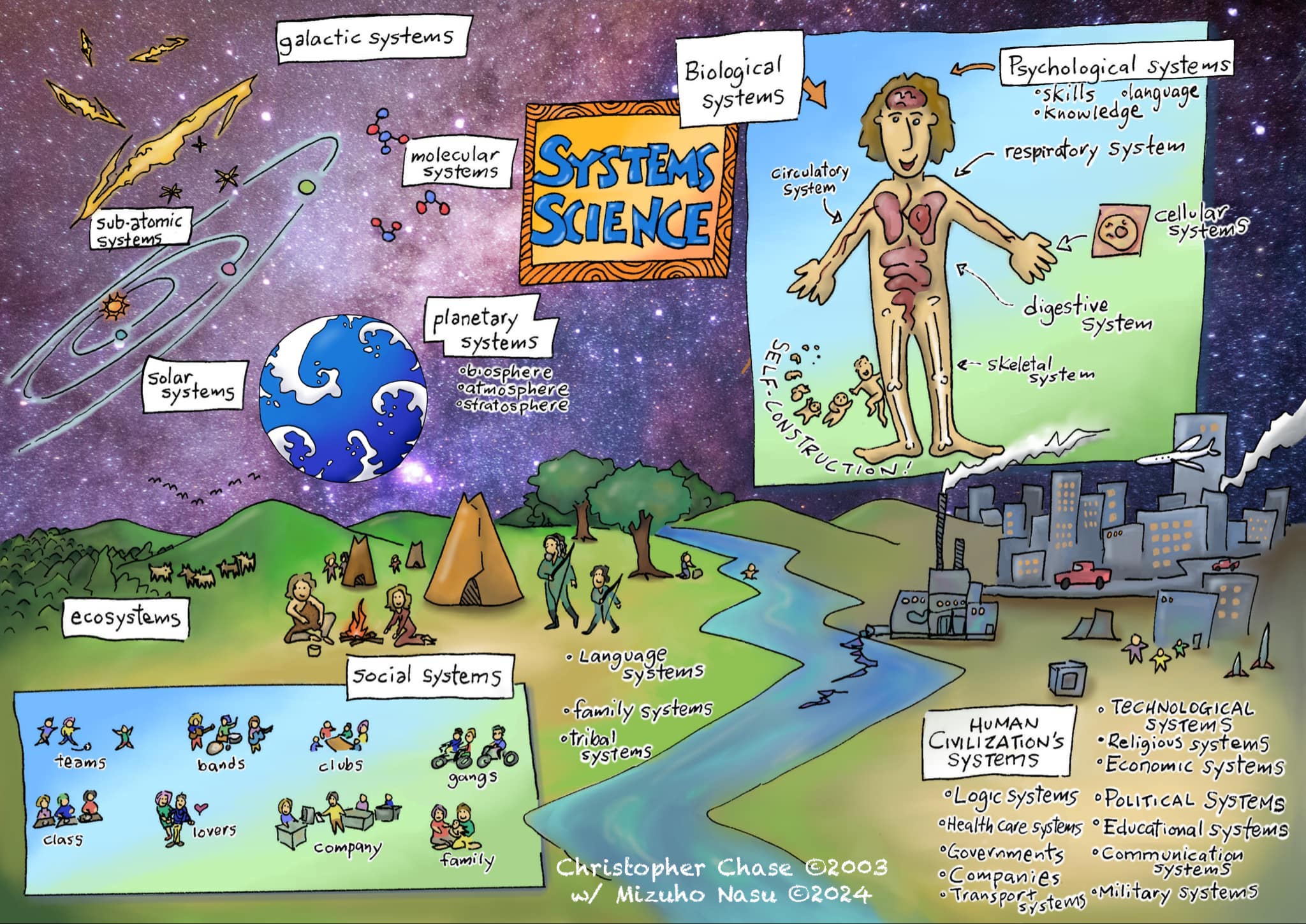
This course builds on the foundational systems concepts, models, principles, and practices covered in introductory courses to this area (pre-requisites include any of the following: HOD-806, ELC-724, IECD-566, or equivalent in MEDIA). It emphasizes non-reductionist and nonlinear ways of knowing, and explores the relations and interconnections that allow any complex adaptive system (CAS) to sustain itself while adapting to and cohering with changing, often turbulent, environments. Through the identification and exploration of auto-catalytic and cross-catalytic feedback cycles in eco-sociotechnical systems, we will familiarize ourselves first with the dynamics of classical autopoietic systems, and then with the emerging understanding at the forefront of systems research on sympoietic systems.
- Faculty: Alexander Laszlo
In this course students develop an understanding of group dynamics inherent in small group interaction in organizations. Using unstructured and structured learning environments students will reflect upon their learning, conflict management, decision making, and communication styles and the impact they may have on others. This course will also explore various aspects of group dynamics such as power, perception, motivation, leadership, and decision-making. This course is designed as a seminar, with an emphasis on discussion and dialogue during our course meetings. This course is divided into 6 Modules: (1) How do we study groups and teams? (2) Group identity, diversity, and context, (3) Team learning and group development, (4) Decision making and other group tasks, (5) Power and leadership in groups, and (6) Managing group conflict.
- Faculty: Laura Black
Write a concise and interesting paragraph here that explains what this course is about
- Faculty: David Blake Willis
Write a concise and interesting paragraph here that explains what this course is about
- Faculty: Philipp Kneis
- Faculty: Frederick Steier
Judgment and decision-making are universal processes—pervasive across disciplines, professions, and everyday life—shaping how individuals, groups, and organizations confront problems and choose courses of action. This course examines how people reason, exercise judgment, and make decisions within diverse contexts, from personal choices to complex organizational dilemmas. It explores how heuristics, biases, emotions, and situational factors influence problem formation, decision processes, and outcomes.
- Faculty: Malcolm North
experiential research using quantitative design, methods, analysis.
- Faculty: Malcolm North
This seminar course provides an opportunity for doctoral students on the path to their dissertations to learn about the process and clarify their own research plans and question. The seminar provides a structured sequence of the early dissertation process, beginning with clarification of a TOPIC area from which research problem can be identified, followed by the formulation of a RESEARCH QUESTION. Aligned with this, is the exploration of supporting and critical literature and prior published research on the topic and exploration of relevant theoretical frameworks and paradigms. In addition, the student begins to identify a primary research methodology and research design.
The seminar provides a structured process for this exploration which results in a draft Concept Paper or early Dissertation Proposal by the end of the term. The seminar provides an opportunity to get feedback from fellow student scholars and the faculty instructor over the different phases of the dissertation process. The seminar does not provide approvals of research as this is done separately by the student's dissertation committee.
The seminar provides a structured process for this exploration which results in a draft Concept Paper or early Dissertation Proposal by the end of the term. The seminar provides an opportunity to get feedback from fellow student scholars and the faculty instructor over the different phases of the dissertation process. The seminar does not provide approvals of research as this is done separately by the student's dissertation committee.
- Faculty: Miguel Guilarte